
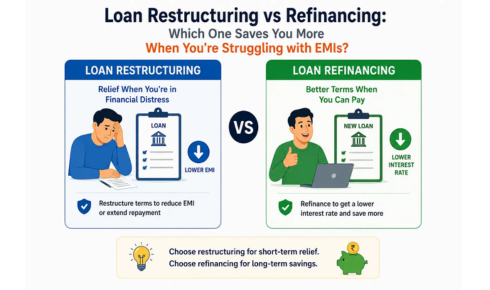
When EMIs start feeling unmanageable, most borrowers panic and either miss payments or rush into another loan to cover the gap. Two structured alternatives exist: restructuring and refinancing, and confusing the two can cost you more in interest, credit score damage, or both.
Loan restructuring means renegotiating the terms of your existing loan with your current lender. This usually means extending the tenure, temporarily lowering EMI amounts, a moratorium period, or converting a floating rate to fixed. Restructuring is usually offered when a borrower is in true financial trouble job loss, medical emergency, or income disruption-and lenders agree to it to avoid a default rather than out of kindness.
Loan refinancing, however, means replacing your current loan with a new one, usually with a different lender at more favorable terms, usually a lower interest rate. Refinancing is a proactive step taken when your credit profile has improved since you took the original loan or when market interest rates have fallen, making it worth switching and reducing your overall interest burden.
Key difference in intent: Restructuring is a distress mechanism; it buys you breathing room when you genuinely cannot meet current EMI obligations. Refinancing is an optimization mechanism; it’s used when you can pay but want to pay less. Using the wrong one for your situation either wastes an opportunity or worsens your position.
Impact on credit score
Restructuring, while it prevents default, is typically flagged on your credit report and can lower your credit score, since it signals to future lenders that you faced repayment difficulty. Refinancing in online loans and quick loans is not necessarily a negative on a credit report if you have a clean repayment history. It is a sign of proactive financial management and not distress.
Cost comparison
Restructuring often extends your tenure, which means paying interest over a longer period; even if your monthly EMI drops, the total interest paid over the life of the loan usually increases.
Refinancing, when it secures a genuinely lower interest rate, reduces total interest paid, though you should account for processing fees, foreclosure charges on the old loan, and any new loan’s fine print before assuming it’s automatically cheaper.
When restructuring makes sense
● You’re facing an income disruption and risk default in the near term.
● Your current lender offers a moratorium or step-down EMI option.
● You need immediate relief more than long-term optimization.
When it’s worth refinancing
● Your credit score has improved dramatically since you took out the loan.
● Market interest rates are dramatically lower than your current rate.
● You can easily meet payments but want a better deal.
The mistake to avoid
Many borrowers wait too long to explore either option, continuing to pay high EMIs or missing payments until their credit score deteriorates to the point where neither restructuring nor refinancing is easily available. The earlier you assess your repayment capacity honestly, the more options remain open.
If your EMIs are becoming difficult to manage, it’s worth exploring both restructuring conversations with your existing lender and refinancing options with new ones before your credit profile takes a hit. You can compare loan options suited to your situation at Airpay Money, which connects borrowers with lending partners offering both structured relief and better refinancing terms.